Landing on Mars, deployment of the Rosalind Franklin rover and first scientific analyses.
12.12.2025
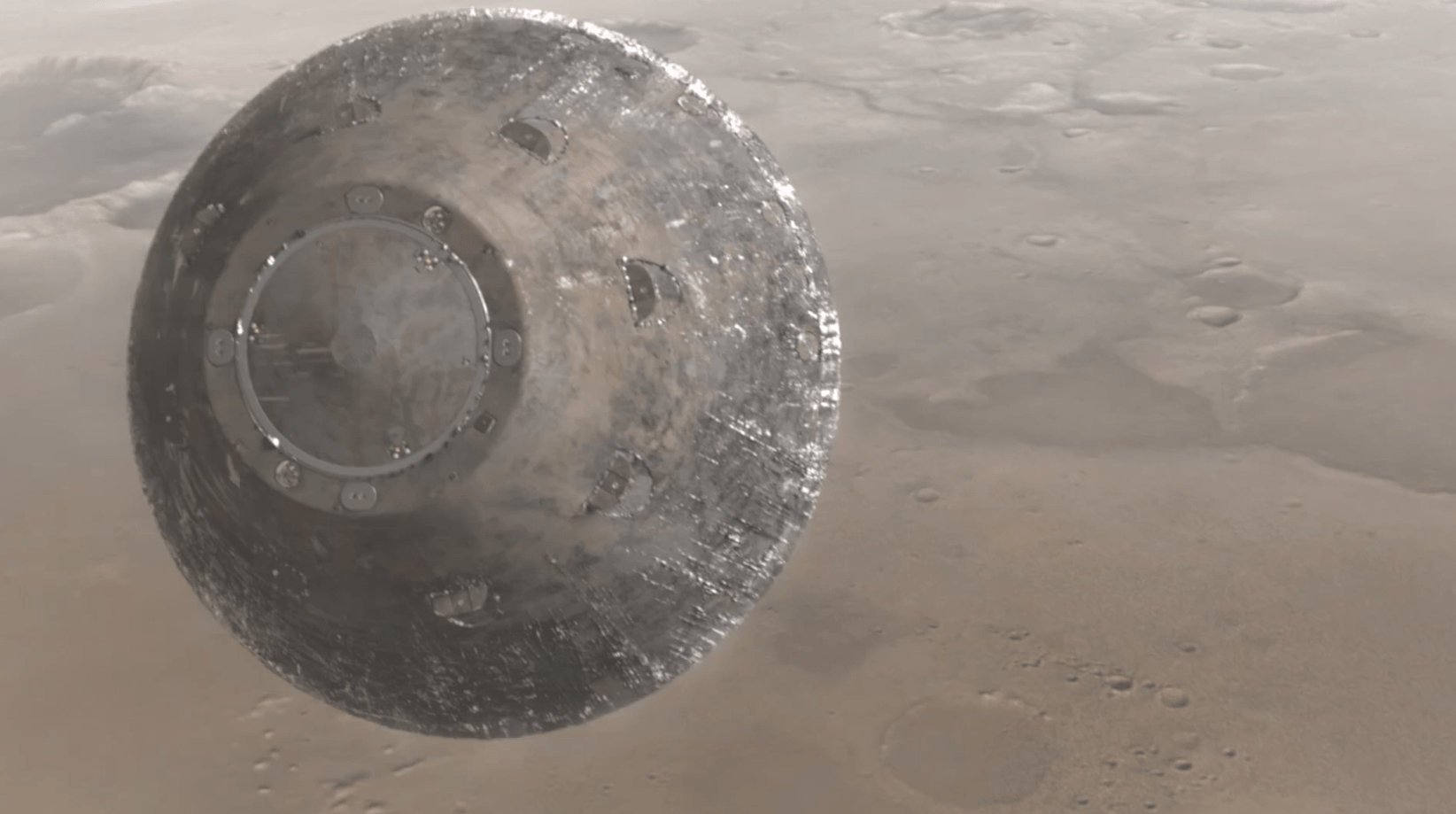
Following the restart of the ExoMars mission — which aims to land the Rosalind Franklin rover on Mars following its launch scheduled for 2028 — ArianeGroup was given a crucial and highly technical mission: to design and build the thermal protection systems (TPS) for the entry capsule. These will protect the rover during the entry, descent and landing phases. They constitute the first line of defence against the extreme aerodynamic and thermal stresses encountered during entry into the Martian atmosphere.
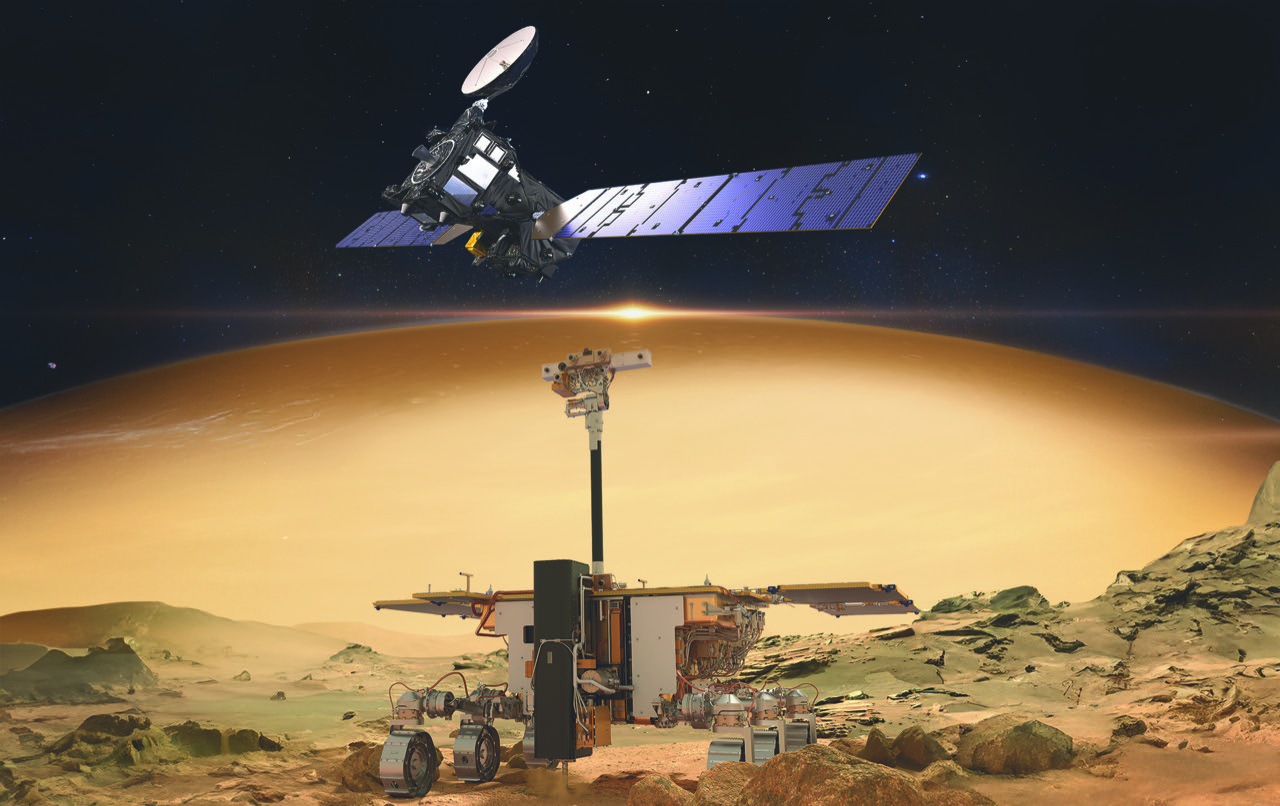
The next great European adventure to Mars is called the ExoMars Rosalind Franklin Mission (RFM). This astrobiology programme is run by the European Space Agency (ESA) with Thales Alenia Space Italy as industrial prime contractor. It aims to land on Mars the first exploration rover designed in Europe, developed by Airbus Defence and Space UK. Its mission will be to search for the biological or molecular signatures indicative of possible life in the red planet’s past. ArianeGroup plays a key role crucial to achieving this scientific goal.
With a mass of 300 kg, the Rosalind Franklin rover, developed by Thales Alenia Space italy and Airbus Defences and Space UK, will carry a suite of cutting-edge instruments. These include a drill capable of extracting samples down to a depth of 2 meters — a world’s first. It is at such depths, sheltered from the radiation and storms on the surface of Mars, that there is the greatest chance of finding traces of past and present life. The samples will be analysed by an on-board laboratory equipped with an infrared microscope and spectrometer, before the data are transmitted to Earth.
© ESA - Thales Alenia Space
To reach its landing zone on Mars, the rover will be carried on-board an approximately 2-tonne entry capsule, 3.8 meters in diameter and 2.4 meters high. On its Issac site, ArianeGroup is designing and building the key components:
At Les Mureaux, the ArianeGroup teams are also bringing to bear their expertise in aerothermodynamics in order to define the specifications for the aerodynamic coefficients and aerothermal loadings during atmospheric entry, which is a critical phase of the mission.
As it enters the Martian atmosphere, the capsule will reach a speed of 21,000 km/h and will be subjected to maximum temperatures of 1,800°C. Thanks to a coat of just 10 mm of space-qualified Norcoat® Liège cork, the structure’s temperature will not exceed 100°C. This technical exploit is made possible by ArianeGroup’s extensive experience in the design of atmospheric entry systems, notably that of the Huygens probe which, in 2005, landed on Titan (one of the moons of Saturn), the Beagle2 Mars lander for the Mars Express mission (2003), and the Schiaparelli probe for ESA’s first ExoMars mission in 2016.
During the descent, a system of parachutes will slow the capsule before separation of the front shield. ArianeGroup also supplies a window capable of withstanding very high temperatures and through which a camera will film the deployment of the parachutes. The landing platform will then gently place the rover on the ground using retro-rockets.
The data collected during this descent will be sent back to Earth from the on-board antennas, via the TGO (Trace Gas Orbiter) which has been in orbit around Mars since the first ExoMars mission in 2016.
The ExoMars RFM programme involves a number of key industrial players. Thales Alenia Space Italy is the prime contractor. Airbus Defence and Space, in Madrid, is the ArianeGroup subcontractor for the supply of the sandwich structure forming the front shield, onto which the protective cork tiles are bonded.
To develop this thermal protection system, ArianeGroup draws on its in-house testing capabilities, notably the SIMOUN plasma torch (5 MW) used to reproduce the extreme conditions experienced during atmospheric entry, as well as a 220-kN shaker used to test the mechanical strength of the front shield’s structure.
The mission is scheduled for launch between 21 September and 26 December 2028. The journey to Mars will take about 24 months, with an arrival in 2030 calculated to avoid the gigantic Martian dust storms liable to disrupt the rover’s solar power production and the scientific measurements.